
Moments of e-vehicle handover and flag off from Bidadi works
April 24, 2026
Enhanced worm gear efficiency in industrial bottle washer application with Berusynth EP 1000
July 18, 2026Less Consumption, Lower Carbon Emission Achieved by Extending Re-lubrication Interval in Bulk Conveyors
Extending relubrication interval for ‘Conveyor Roller Bearings’ reduces maintenance activity, significantly cuts down risk exposure and creates a safer work environment and also reduces carbon emission due to lower grease consumption.
Conveyors are the circulatory systems of bulk material handling operations across industries. They bridge the gap between extraction, intermediate-processing, and manufacturing by providing heavy-duty, high-capacity transport over both short and long distances. They are designed to transport heavy duty bulk materials such as ore, coal, sugar, food items, etc from one place to another in industries such as steel, cement, mining and mineral processing, sugar and other food processing sectors. They are the modern alternative to truck transport and save time, cost boosting production and throughput.
Enhancing Safety Quotient, Reliability of Conveyor Pulley with Long-Life Lubrication
Conveyor system maintenance requires a proactive, component-focused strategy. Key tasks include daily cleaning, routine or periodic bearing lubrication, and adjusting belt tension and tracking etc.
However every time maintenance team undertakes the re-lubrication exercise, it is an unsettling experience for the personnel due to the high-risk quotient associated with the activity. A root cause study published by the ‘American Society of Safety Professionals’ on ‘serious and fatal accidents’ focusing on conveyors over a period of 20 years, attributes 50% of the cases to ‘maintenance, cleaning and lubrication activity’ on a moving belt.
Relubrication of pulley bearings is an activity that cannot be avoided. But can it be extended? With conventional extreme pressure (EP) greases, the relubrication interval maybe stretched to 30 days, any further delay or extension of relubrication activity will result in bearing failure and downtime. Extending the re-lubrication interval with long life greases, can not only reduce lubrication consumption but more importantly reduces the exposure of the maintenance team to a high risk, re-lubrication activity.
Below case study highlights how lubrication practices can improve operational efficiency while fostering a safer work place and reducing carbon foot print.
Customer : An integrated steel manufacturing facility designed for efficient production of high-quality steel using energy-efficient technologies. Known for its focus on operational excellence and safety, the company plays a vital role in meeting the demand of core sectors such as infrastructure, construction and manufacturing.
Customer was using conventional EP 2 grease.
Challenges encountered by the maintenance team:
- Higher grease consumption (every 30 days)
- Frequent re-greasing exercise increased man- machine interference, posing safety risks
Operating conditions:
- High contamination of wet and dust particles
- Poor sealing conditions
- Presence of impurities (e.g., sulphur)
- Slow-speed, high-load operating conditions
- Frequent lubrication increasing contamination risk
Considering operational challenges, BECHEM team recommended and initiated a trial with BECHEM High-Lub LM 450 K, a heavy-duty grease formulated with extreme pressure additives.
Trial procedure:
- Type of Greasing: - Manual Greasing.
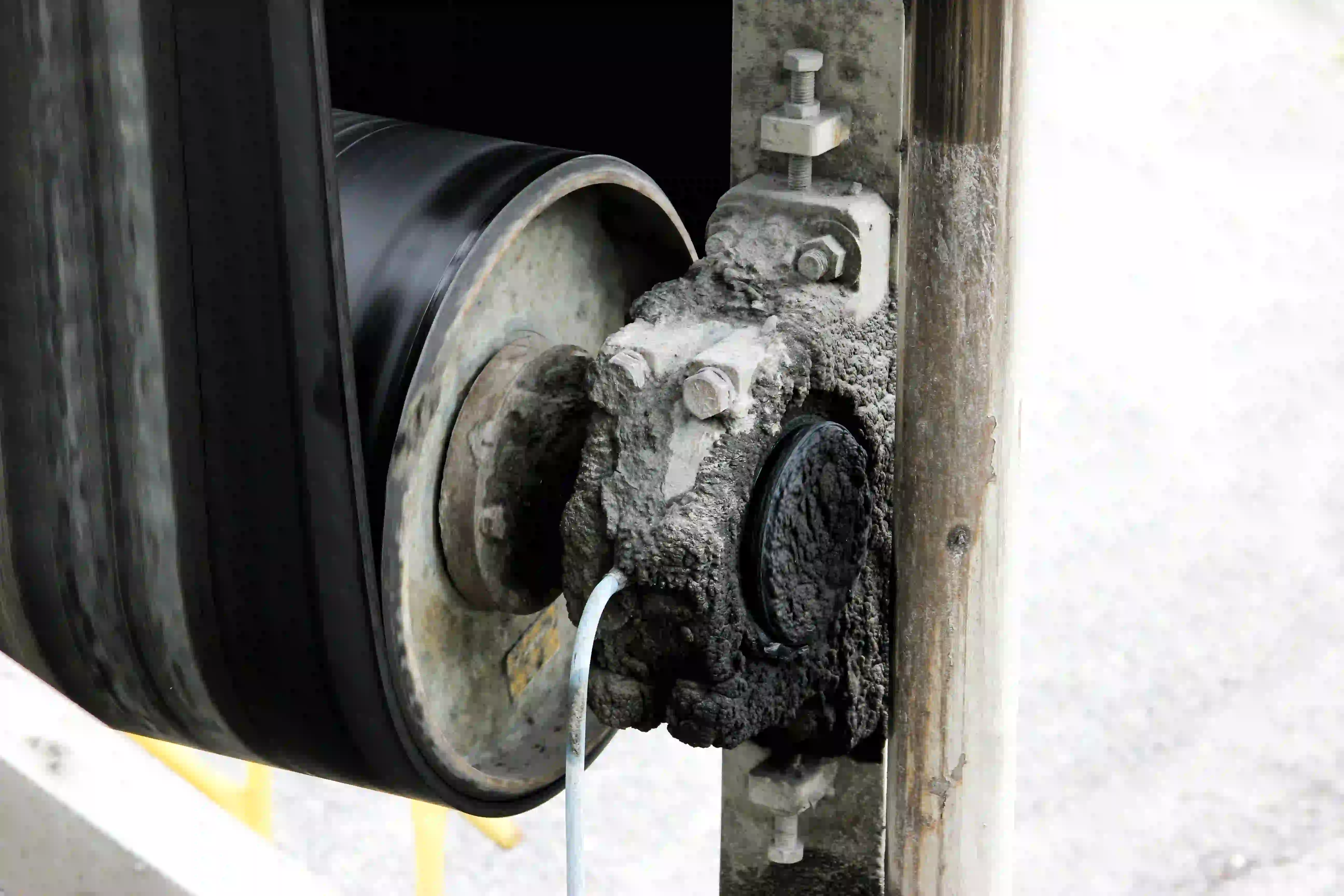
- Pulley- Tail Pulley and Take-Up Pulley
- Belt Speed – 3.2 m/sec
- Conveyor –J3C2 Convey
- Bearing type- Spherical roller bearing
- Bearing No- 23136 (Outer Diameter – 300 mm, Inner Diameter – 180 mm, Width – 96 mm)
Observations :
- During the trial period, bearings demonstrated stable performance with no abnormal rise in temperature, operating consistently within normal conditions.
- After 6.5 months, lubricant condition remained intact, with the grease retaining its fresh appearance and consistency, indicating no significant degradation (results are presented below).
Comparison table :
|
Description |
Conventional EP 2 grease |
BECHEM High- Lub LM 450K |
|
Re-greasing interval |
Once in 30 days |
Once in 6 months |
|
No. of top ups in 6 months |
6 |
1 |
|
Top up quantity (kg) |
2.5 |
2 |
|
Total consumption in 6 months (kg) |
15 |
2 |
|
Manpower required per greasing |
2 |
2 |
|
Total manpower required in 6 months |
12 |
2 |
Based on bearing condition, relubrication intervals, and operational parameters, the cost–benefit analysis demonstrated approx.62% cost savings with BECHEM High-Lub LM 450K over the conventional grease.
Reduction in Carbon Foot Print
Section |
Details |
| Objective | Carbon emission reduction by replacing Conventional EP2 grease with High-Lub LM 450 K |
| Standard Reference | GHG Protocol, API TR 1533 |
Input Data |
|
| Grease Type | Conventional EP 2 |
| Total Grease Consumption (6 months) | 24 kg |
| Grease Type | BECHEM High-Lub LM 450 K |
| Total Grease Consumption (6 months) | 3 kg |
| Reduction in consumption | 21 kg for 6 month (87%) |
Emission Factor |
|
| Emission Factor | Estimated 2.7 kg CO2e per kg grease (Standard industrial value) |
Calculations |
|
| EP 2 Emissions | 24 kg × 2.7 = 64.8 kg CO2e (6 months) |
| High-Lub LM 450 K Emissions | 3 kg × 2.7 = 8.1 kg CO2e (6 months) |
| Net Emission Reduction | 64.8 − 8.1 = 56.7 kg CO2e (6 months) (88%) |
| Annualized Reduction | 113.4 kg CO2e per equipment per year |
Importance of reduction in 114 kg CO2e to environment
- Saving 114 kg CO₂e per year is equivalent to planting and growing about 5 mature trees for one full year (CO₂ prevented from entering the atmosphere is the same amount that approx. 5 mature trees would remove from the air in one year)
- Avoiding approx. 280–300 km of car driving per year.
- Equal to the electricity consumed by an average Indian household for approx. 1 month
Trial results :
- BECHEM High-Lub LM 450 K has significantly reduced man-machine interference, thereby enhancing safety during maintenance activities. It also led to lower operational and maintenance costs, along with a noticeable reduction in grease consumption.
- Lesser grease consumption with BECHEM High-Lub LM 450 K would reduce carbon emission by 114 kg per year per equipment.
Conclusion :
Satisfied with the improved performance, reduced costs and extended service intervals, the customer switched over to BECHEM High-Lub LM 450 K and also, began using it in other application like J4C2 take-up pulleys.